
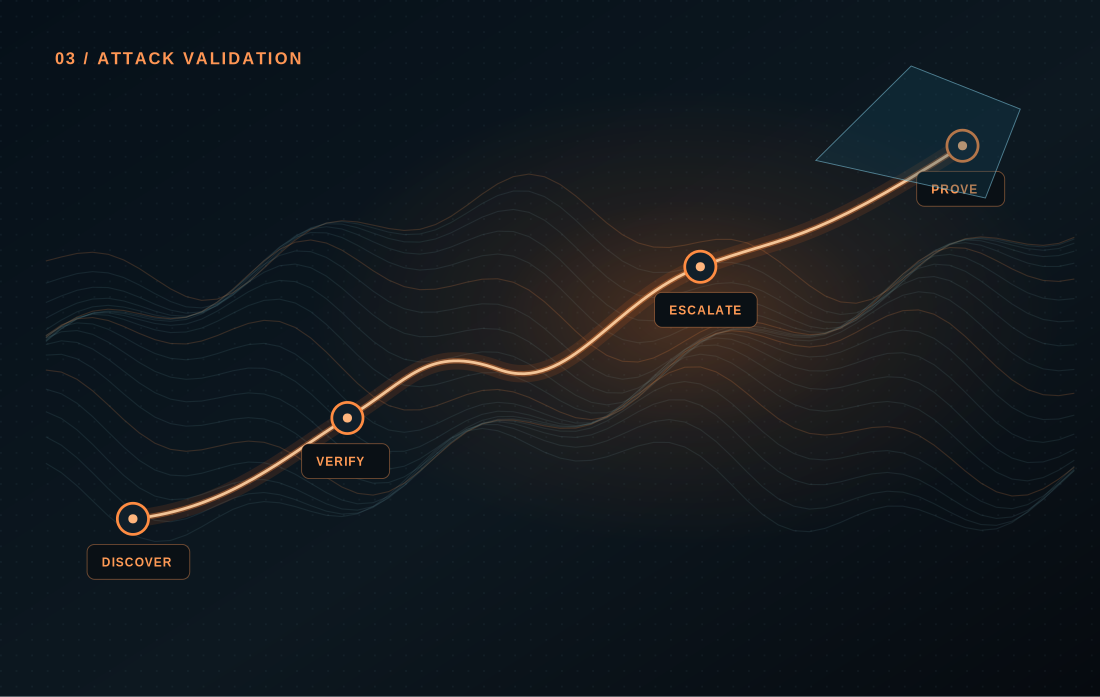
Which findings create a credible route to the assets that matter?
An exposed application, overly broad permission or missing control may be serious in isolation. Buyers need to know whether those weaknesses connect into an actionable path toward a critical business asset—and where a defender can interrupt that path.
From isolated signals to testable hypotheses
- 01
Establish the objective and boundaries. Agree the critical assets, permitted test surface, exclusions, safety limits and evidence standards before validation begins.
- 02
Connect exposures into candidate routes. Correlate public-facing signals, reachable systems, identity or workload permissions and the controls separating them from the objective.
- 03
Validate and explain. Record the actual observation, any control that prevented progression, the confidence level and a corrective action that can be tested again. Sensitive data is not required to demonstrate the decision.
One attack-path record a security leader can use
A focused proof-of-value can be organised around up to five prioritised routes to agreed critical assets. Each route has its own asset context, tools and tests in scope, validation evidence where available, defensive observations and remediation priority. The number of valid paths depends on what testing actually supports.
From suspected exposure to a decision
Could a reachable application or configuration be used to cross a defined trust boundary?
Permitted test, redacted observation and control response. Label the path validated, blocked, inconclusive or not tested—never infer success from severity.
Confirm the responsible owner, the control to improve and the next safe validation step.
Illustrative report format, not a verified finding from a customer engagement. Validation results must always be supported by engagement evidence.
Prioritisation that goes beyond vulnerability counts
- Separate technically confirmed routes from assumptions requiring further testing.
- Explain which access or security-control boundary matters to a critical business process.
- Give accountable teams a narrower, evidence-led remediation and retest sequence.