
Align on the decision
Clarify the business concern, the environment and what a useful answer must enable.
From a single security question to a complex programme, our starting point is the same: understand the decision, establish the right evidence and agree on what useful progress looks like.
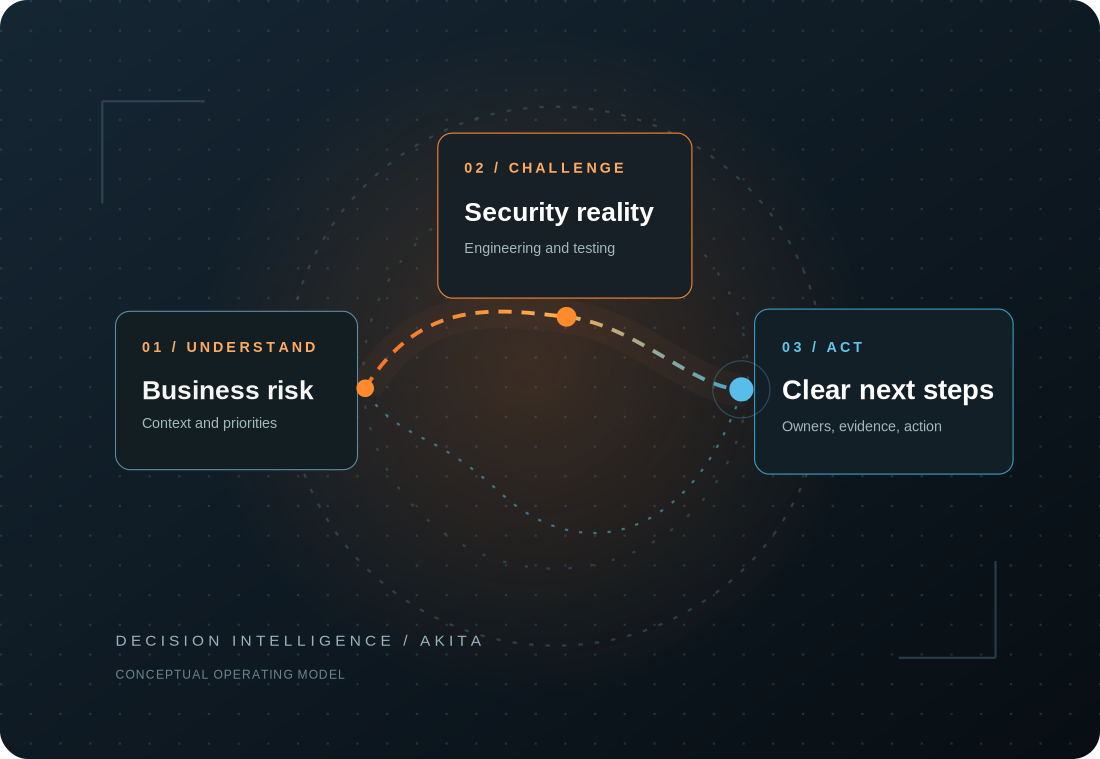 Illustrative model, engagement scope agreed individually
Whatever the engagement, buyers should know how Akita gets from a difficult question to a practical next move.
Clarify the business concern, the environment and what a useful answer must enable.
Agree on boundaries, evidence, stakeholders and the most useful way to proceed.
Advisory, engineering, monitoring or adversarial validation shaped by the challenge.
Findings translated into owners, priorities and the next action the organisation can take.
Scope is adapted to your environment. These are the practical questions to settle early, not fixed promises about every engagement.
Agree business objectives, assets, exclusions, operating constraints and the evidence needed to answer the initial question.
Identify decision owners and relevant technical stakeholders. Assign coordination and communication paths before work starts.
Define the audience and format for findings, supporting evidence, improvement actions and any leadership briefing.
Agree how priorities are tracked, which actions need validation, and whether follow-up support is appropriate.
Illustrative method, not a claim that a specific customer was compromised. Each assessment begins with critical assets, starting points and agreed rules, then examines plausible routes through applications, identities, networks and controls.
Agree the critical service, authorised scope, exclusions and evidence rules.
Consider starting exposures, trust boundaries and current relevant attack techniques.
Record observed exposure, controls that prevent progress and remaining uncertainty.
Relate observations to business consequences, assign owners and agree verification.
Summaries based on actual Akita projects; customer identities and sensitive details are withheld.
Explore the structure of the work products we discuss with clients. Illustrative frameworks, showing how evidence can support an actionable decision.
A representative structure for connecting requirements, owners and next actions.
An example of the steps from detection signal to operational response.
An illustrative way to present attack paths, control observations and remediation priorities.
No prepared brief required. If you prefer Hebrew, the contact page remains available.